
The Secret Code Behind Every Decision You Make – And Why Most People Are Stuck Overthinking
And are completely unable to make simple decisions


As people age, they become more indecisive.
It’s tragic to watch. The average person now can’t make simple decisions. Not because society is getting stupider, but because our minds are full of noise.
The constant brain drain of phones, AirPods, gurus, and TikTok means we can’t think clearly. So our rate of making decisions is on the decline.
There’s a hidden code that runs in the back of your mind and secretly drives your decision-making ability. If you understand this code, you can:
make decisions faster
avoid overthinking
make a bad decision and still win
Let me share with you how this code works, backed up by everything I’ve ever read about the art of decision-making and how the best in the world do it.
The curse of overthinking has killed more hopes and dreams than cancer
Most people don’t make decisions because they fear failure.
But overthinking kills more people’s goals than failure does. When you make a decision you’re simultaneously rejecting all the other options. The decision sets your priority which tells you what to focus on.
People who can’t make timely decisions indulge in fantasies that ultimately expire because no opportunity stays alive forever. “Just thinking about it” doesn’t produce a decision. Deciding and then pivoting if something is off is what the top 1% do.
99% of decisions are reversible.
What’s not reversible is years of procrastination and fantasies of what you could have done while wasting any potential you may have had.
Inaction isn’t reversible either.
There is a secret you don’t know about making decisions: It’s called you wouldn’t have known the alternative so it doesn’t matter – Gary Vee
What you can learn from the man who stopped the world from nuclear annihilation
On September 26, 1983, Stanislav Petrov was in charge of a bunker in Moscow.
His only job was to monitor if any nuclear bombs were heading towards Russia. If he saw any, he had to tell the Kremlin.
As the clock went past midnight, red sirens in the bunker started going off. The computer told him the USA had launched nuclear warheads.
Things got worse… much worse.
The screen showed four more bombs were on their way. SH*T! This was at the height of the Cold War so Stanislav had to follow a checklist and set of rules. His first job according to procedure should have been to report the strike so Russia could retaliate and blow up the U.S.
Russia had 25 minutes until it became a pile of rubble.
At first, Stanislav’s balls started to sweat. The data was clear. The operating manual was clear. If the average normie in society were in his seat, they would have sat there, drowning in what-ifs and pros and cons lists until their face got melted off by a nuclear bomb, and humanity went extinct like the dinosaurs.
But something was missing from Stanislav’s manual.
The computer seemed way too certain (the way AI is nowadays). Sending five missiles seemed like a tiny number to him. You’d fire more than that if you were serious about ensuring the job was done.
In an instant, he decided the computer was wrong. He called it a false alarm and told the bosses. Turned out he was right. The satellite mistook the sun’s rays for missiles.
If he’d overthought it or done anything different, we would have had World War III.
Yet here we are still breathing thanks to his decision-making framework. He saved the world because he didn’t just blindly follow a system like most people. He questioned the system. He used logic. He let his experience guide his intuition.
Most of all, he made a swift decision that was better than no decision.
The speed of your decision-making matters. It can save your life and produce endless opportunities.
Making a decision is a camouflage for something bigger
I always thought I needed to get better at making decisions.
I realised there was a hidden truth: big decisions are secretly asking you, are you willing to change or are you happy to stay the same?
Author Kevin Kelly says, “Whenever you can’t decide which path to take, pick the one that produces change.” Most people don’t make decisions that produce change, so their rate of iteration is either slower than a snail or non-existent.
When they describe this problem to others, they say something like “I feel stuck.” Feeling stuck is what NOT changing and iterating causes.
Make decisions that lead to change if you want to get unstuck.
Start making these types of decisions if you want to reach a level of success most can only dream of
You’re likely okay at making simple decisions. Safe decisions.
The decisions people avoid are the hard ones. The ones that carry risk. “Hell Week” author Erik Bertrand Larssen offers this advice:
“A choice without risk is either a false choice or a choice not worth making.”
To become the man in the arena, you must start making decisions that have some risk.
Dr Julie Gurner takes it a step further: “Most people make choices based on their fears or insecurities - not their ambitions & aspirations.”
Until you shift the core of your decision-making from focusing on what you want, instead of what you don’t want, you’ll never make the important decisions that completely change your life in a year.
Losers aren’t losers. They’re just humans who are stuck only making easy decisions. Raise the stakes if you want to raise the bar in your life.
Implant this mental model into your brain:
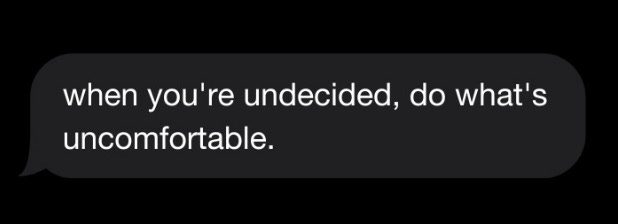
There’s a deeper level of decision-making that produces transformations
Hard decisions are fine. Discomfort is fine.
But what if you’ve been stuck for ages? Does simply running a marathon solve all your problems? Likely not. This is when you must burn it all to the ground.
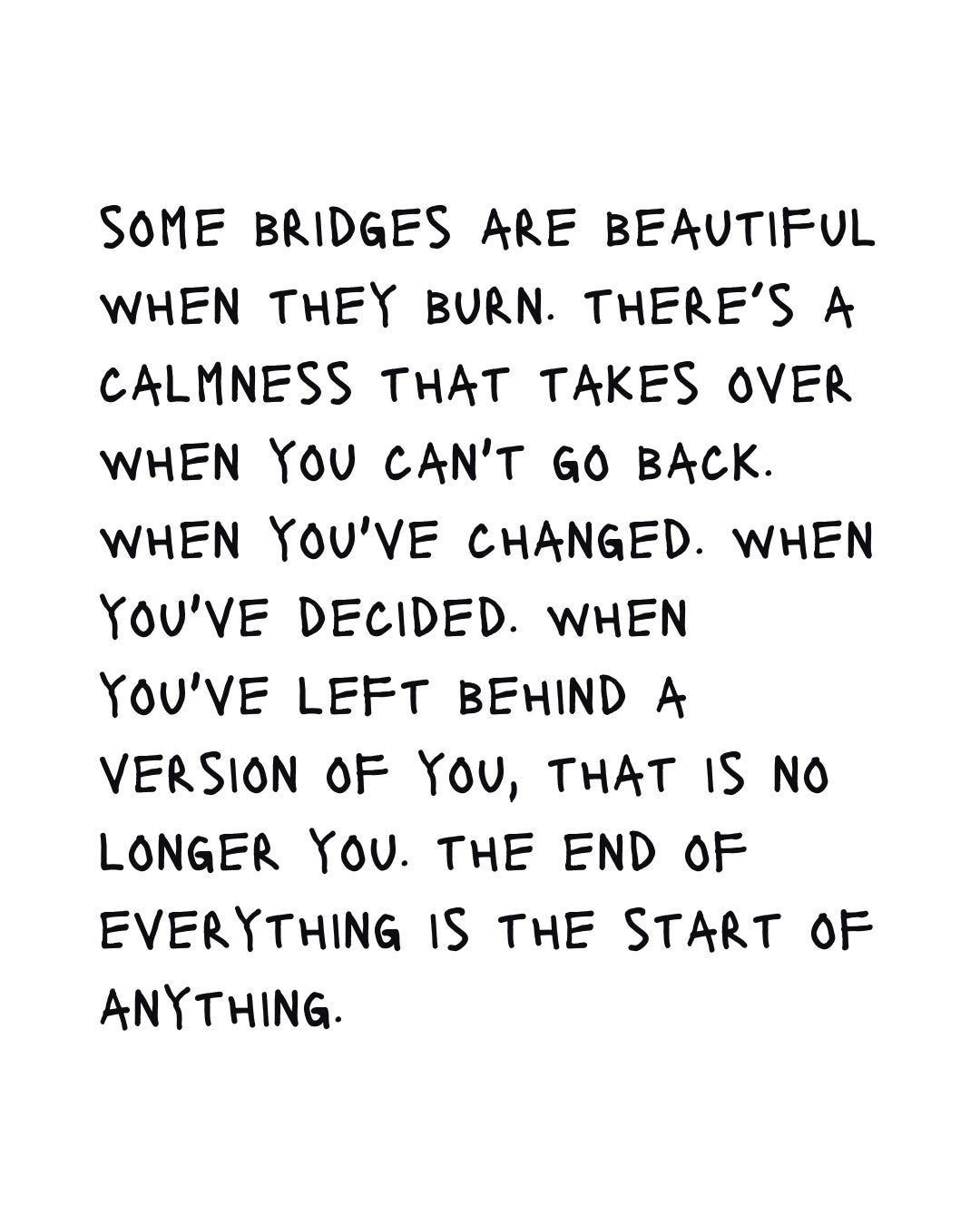
Drastic decisions are the hardest to make.
This is because of the sunk cost fallacy. We focus on what we’ve already invested in time, money, effort, and resources. Starting again means giving all that up, and that feels like a loss. Humans are always driven more by pain than they are by pleasure.
When I had to burn my banking career to the ground, it was an ego death. 10 years of life wasted. The chance of not being able to ever get a job again if I failed.
I still burned it all to the ground.
What changed my mind was when my dad told me the coolest people live multiple lives during their one life. They constantly reinvent themselves. They’re chameleons. They can change their tiger stripes to leopard spots if they want to.
When he told me this I realized I was already doing this subconsciously. I’d been a drummer, DJ, entrepreneur, banker, and wannabe self-help guy already.
Burning your life to the ground isn’t about a new decision. It’s about experiencing an ego death so that you can reinvent yourself.
The spectacular tragedy of indecision
More is lost by indecision than wrong decision – Marcus Tullius Cicero
Decision-making is a muscle. And most people have limp d*ck biceps in this area of life. What is easy to miss is that not making a decision is a decision.
I met this dude online once who said to me in a DM, “A maybe is a no in denial.” I freaking love that. I find it best to delete maybe from your vocabulary.
The illusion of the “right” decision
A maybe happens because you believe there is a right decision.
This is also a lie. Writer Dickie Bush once said in a YouTube video, There is no “right” decision because each decision just leads to a different set of problems.”
Once you understand there is no perfect or right decision, it frees you to decide.
If you agree that every decision leads to a series of more problems, then you’ll realize a lot of people fail because they see problems as bad, just like they see stress as a sign to quit or take a year off.
Being afraid of problems is the problem.
For example, I started a business to have more freedom. And I got it, but I also got much higher prepaid taxes, and clients that I had to service. In a way, “mo money, mo problems” is extremely accurate. So the only choice is to see problems as opportunities you’re blessed to have because those in the cemetery don’t get that gift.
The one regret I have about quitting banking is I didn’t do it sooner. Entrepreneur Jason Fried reminded me of this when he said “Every difficult decision would have been easier had I made it earlier.”
Staying in a bad situation makes the negative consequences worse.
When sh*t hits the fan you’re better of deciding that day rather than drowning in overthinking and overanalyzing.
Let me blow your mind and prove the power of emotional decision-making
In the 80s, a dude known in medical journals as Elliot underwent brain surgery.
They removed a small tumor from his head. Things went well. Until doctors noticed a big problem: Elliot couldn’t make simple f*cking decisions.
The doctor asked him to choose a date for his next check-up appointment. Elliot turned into a bumbling professor studying his 3rd PhD. All he had to do was choose between Tuesday and Wednesday.
Get a load of this. An otherwise normal man started analyzing the weather, traffic, statistical likelihood of a flat tyre, and even the freaking ink levels in his pen. Even with that data and logic, he couldn’t decide.
Bizarrely, it turned out later that the surgery had severed the link between his logic and emotions. Without emotion involved in his decisions, he was a vegetable on life support that couldn’t function.
Smart people suffer the same fate. They have all the facts, figures, and degrees, but all it does is trap them in infinite analysis.
This goes against mainstream culture.
People often think emotional decisions must be avoided when they’re the secret antidote to everything they desire. People aren’t stuck in life because of a character flaw. It’s because they make decisions without emotion and intuition.
The past is the boogie man that f*cks up people’s current decisions
This decision-making code is going to get weirder.
People will stay stuck in indecision because of a past bad experience. They’ll say “Well, I did this thing last time and it didn’t work so I’m worried it’ll happen again.”
Here’s what’s wild: often it’s only one bad experience that causes this.
The best way for me to explain this phenomenon is with my friend Nikita. She’s a lovely woman. Someone I look up to. She’s good-looking and stunningly successful. Yet she hates men and never wants to be with another one again, despite being attracted to them.
One night over a few cocktails (I drank lemon water) she told me the backstory. When she was 21 she dated a terrible man. He said he loved her. He asked her to marry him. Then she found out he’d cheated on her with a worker at a hotel they were staying at on a romantic couple’s holiday.
From that day on she never dated another man. She swore off them. She humiliated them. She even started a feminist brand in LA.
When you analyse what happened, she had one bad experience with a man and then assumed all men must be like this terrible man. It’s illogical because you don’t date one person and marry them (most of the time). You date several people, and then you may eventually marry one of them.
This is how people make decisions. They let a bad experience throw them off course. It’s because they label the experience as a failure rather than a learning experience.
The past doesn’t equal the future.
Business guru Alex Hormozi takes the idea further. He says when you need to make an important decision and you don’t do it because of a past failure, you’re letting a sh*tty situation burn you twice.
The first time - when they wronged you.
The second time - when you let it stop you from making the right choice.
Stop letting one failure cause you to lose twice.
Don’t let your agenda become a list of everyone else’s agendas
Most people don’t own their lives.
They make decisions and set their to-do list based on other people’s priorities while quietly letting their own hopes, goals, and dreams fade to dust.
It’s a modern tragedy.
No one does this because they’re stupid. It’s because they don’t know what is important, and they don’t really know what they want to do with their life.
This is why it’s crucial to have a mission. It defines your why in life. It tells you what to ruthlessly focus on. And anything outside of the mission becomes an easy no. The mission gives you a decision-making framework. You can even blame the mission for every no. “Sorry Bob, can’t do the podcast chief as I’m in training for the marathon.”
Most people don’t need more time to decide. They need to choose a mission in life and go after it like a psychopath.
“Always consult your ideal lifestyle before making an important decision” – Dan KoeThere’s another level to this.
It’s common to think you need to make 100s of good decisions in your life to achieve your version of success. So you treat every tiny decision like it’s going to arm a nuclear warhead and blow up America. I’ve found another approach…
You only need to make 1-3 good decisions to live the good life. All the other decisions are rounding errors and don’t affect the overall outcome much.
Formulas you can use to make better decisions, faster
When faced with a difficult decision, a good reframe is all it takes to get you unstuck. These are the formulas I pass decisions through:
If I can’t decide, the answer is no.
If it’s not a f*ck yes, the answer is a no.
If it’s not part of the immediate mission, the answer is no.
If you don’t use a formula that helps you make a decision with a clear yes or no, you end up stuck in the p0rn fantasy land of maybe.
Podcaster Scott D Clary reminded me “Maybe is just a no with anxiety.” And “let me think about it” is a no with hope. Stay away from the middle ground. I find when I say maybe or I’ll think about it, it generates more work because now the person has implied permission to obsessively follow up with me.
The right decision normally feels obvious.
Making decisions that lead to desired solutions is impossible
Wait, what?!
That’s right. I’m not here to be your little agreeable f*ck buddy. Real wisdom is found in paradoxes. Making a decision not only creates new problems for you – it also solves nothing either. Political commentator Thomas Sowell explains:
“There are no solutions. There are only trade-offs.”
Once you consciously know this you stop trying to make perfect decisions or the “right decision” and just decide, knowing you took the best set of tradeoffs and you will eat your humble sh*t pie and go home for a bone alone.
Bringing it all together
You now have the secret code that quietly runs in your head every time you attempt to make a decision. Reinstall these decision-making frameworks into your mind’s software, and you’ll be able to:
Make faster decisions
Never say maybe again
Stop “thinking about it”
Choose the hardest option with a smile
Avoid letting past experiences screw you
And make decisions that lead to real change
Overthinking is cancer. Cure yourself.
There is no right decision. There are simply unmade decisions that hold you back in life without you always knowing why. Every decision is reversible.
Decide, then pivot if you need to.
P.S.
If you really want to stop overthinking, you’ll like this...
My latest YouTube video sent people in waves to my inbox.
Guess I hit a nerve.
Curious?
Been there .... been impulsive and waited too long. Great article - I am going to apply this to an area I'm currently in. Thanks
Thanks, Tim! You told me that I've done it right all along, and I can vouch for your prescription, which everyone can and should follow! I've made major career changes several times, each of which was a big risk and turned out to be right at the time for our desired goals and lifestyle.